

If you’re a smoker in 2026 thinking
seriously about quitting, you’re attempting it at the best-equipped moment in
history. The tools available to today’s quitter would have seemed like science
fiction to someone stubbing out their last cigarette a decade ago — a whole
spectrum of smoke-free nicotine products, each proven to help people leave
cigarettes behind, alongside the traditional clinical routes that still work
well. But more choice also means more confusion, and the wrong first move can
turn a promising quit attempt into another failed one. This guide is a
practical, honest roadmap for the smoker ready to switch: how to choose your
approach, how to get the crucial details right, what the first weeks actually
feel like, and how to build a switch that sticks. It’s not about willpower
slogans — it’s about picking the right tools and using them properly.
Why Willpower Alone Rarely Wins
Start with the hard truth that
reframes everything: for most smokers, willpower alone has a poor success rate,
and that’s not a moral failing — it’s pharmacology and psychology. Cigarettes
deliver nicotine fast and pair it with a deeply ingrained set of rituals and
triggers, and cold-turkey attempts ask you to fight both the chemical
dependence and the behavioural habit simultaneously, with nothing to replace
either. The smoke-free products that have transformed quit rates work precisely
because they don’t demand that impossible double battle — they replace the
nicotine, and the better ones replace the ritual too, letting you dismantle the
habit gradually rather than all at once. Understanding this is liberating: your
past failures probably weren’t weakness, they were attempting a genuinely hard
task without the right tools. The 2026 toolkit exists to make the task
achievable, and choosing well from it is most of the battle.
Mapping Your Options
Your smoke-free options fall into a
few clear groups. Vaping is the most popular, delivering nicotine through
inhaled vapour and closely mimicking the act of smoking — for most switchers, a
simple pod kit is the natural entry point. Nicotine pouches deliver nicotine
through the gum via a small tobacco-free pouch under the lip — discreet,
invisible, hands-free once in place. Traditional nicotine replacement therapy —
patches, gum, lozenges, sprays — offers a clinically-backed, pharmacy-guided
route with decades of evidence. And many successful quitters combine
approaches, such as a long-acting patch with a fast-acting product for
cravings. There’s no single ‘best’ — the right choice depends on you, and
specifically on which parts of smoking you most need to replace. The next
sections help you match yourself to the right starting tool.
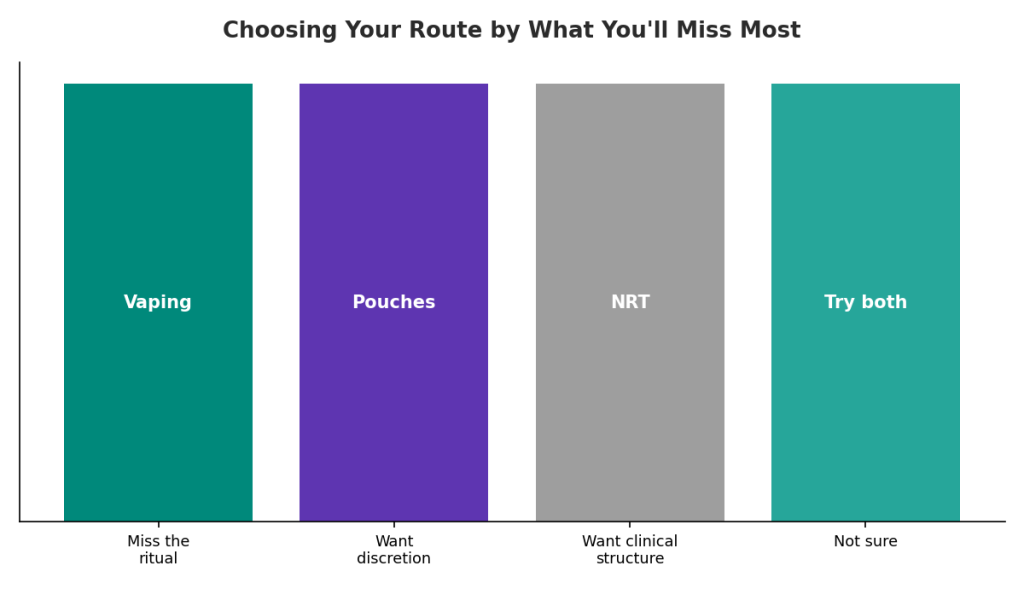
Choosing your smoke-free route — matching
the tool to what you most need to replace.
Choosing by What You’ll Miss Most
The most useful question isn’t ‘which
product is best’ but ‘what will I miss most about smoking’ — because the answer
points to your tool. If you’ll miss the physical act — the hand-to-mouth, the
inhale, the exhale, the pause it gave you — then vaping is your natural fit,
because it preserves that ritual better than anything else, and rechargeable pod kits are built precisely for switching
smokers who need that behavioural replacement. If you’ll miss the nicotine but
not particularly the ritual, and you value discretion, nicotine pouches may
suit you better — invisible, usable anywhere, no cloud. You may also want to
understand what is snus and how it differs from modern nicotine pouches.
If you want maximum clinical structure and pharmacy support, traditional NRT is
excellent.Be honest with yourself here, because matching the tool to the genuine gap is what separates a switch that sticks from one that quietly collapses when the missing element pulls you back to cigarettes. Choosing suitable vaping options, including Hayati Flavours, can also help make the transition more appealing for smokers who value variety.
The Detail That Makes or Breaks It: Strength
Whatever route you choose, one detail
matters more than any other, and it’s the one people most often get wrong:
nicotine strength. The instinct is to be cautious and start low, but
under-dosing is the single biggest cause of failed switches — an under-strength
product leaves cravings unmet, you compensate or grow frustrated, and
cigarettes win. The correct approach is to match your starting strength to your
actual smoking habit. For vaping, a ten-a-day-or-more smoker should start at
20mg nicotine salts, not a timid lower strength. For pouches, choose a strength
appropriate to a switching smoker rather than a first-timer’s dose. For NRT,
follow the dosing guidance for your consumption level. Reduction comes later,
deliberately, once your switch is stable — not on day one out of caution.
Getting this right at the start is arguably the most important single decision
in your whole quit attempt.
What the First Weeks Feel Like
Setting expectations protects your
switch. Week one is substitution: use your chosen product wherever you’d have
smoked, don’t ration yourself, and treat any cigarettes that still happen as
data rather than failure — every one replaced is a win, and the pattern usually
shifts toward your new product as trust builds. Expect the product to feel
simultaneously familiar and slightly different; give it a fair week rather than
judging on day one, especially as your smoke-conditioned palate and habits
recalibrate. Weeks two to four are consolidation: the trigger moments — after
meals, with coffee, under stress — arrive on schedule and get handled with the
new tool until the automation transfers. Somewhere around day ten to fourteen,
a wobble of doubt visits most people and passes. By week four, many successful
switchers report whole stretches where cigarettes simply didn’t cross their
minds — the quiet sound of a habit changing hands.
Building a Switch That Sticks
A few habits dramatically improve
your odds. Keep your product where your cigarettes lived — same pocket, always
charged or stocked — so it’s the first thing your hand reaches for. Keep a
spare, whether that’s a spare pod, a spare tin of pouches, or spare gum, so a
supply gap never becomes a relapse. Consider a two-tool approach — many people
use vaping for ritual moments and pouches for discreet ones, and the
combination covers more of your day than either alone. Let any ‘just one
cigarette’ thought pass rather than testing it, especially in the fragile first
fortnight. And don’t rush to cut your nicotine — the reduction stage comes once
smoking feels genuinely foreign, typically months in, not weeks. Buy genuine
from established UK retailers throughout, since fake products are a needless
risk at a delicate time.
Combining Tools for a Stronger Switch
One approach worth highlighting for
anyone serious about quitting is combining tools, which the evidence and
experienced quitters both support. A long-acting nicotine patch paired with a
fast-acting product for breakthrough cravings is a recognised NRT strategy;
similarly, using vaping for ritual moments and pouches for discreet ones covers
more of your day than either alone. The logic is simple: cigarettes served many
functions — the ritual, the discreet hit, the craving relief — and no single
replacement covers all of them equally, so a small toolkit often holds up
better than a single product against the varied moments where cigarettes used
to appear. This isn’t about using more nicotine; it’s about ensuring you’re
never caught in a situation where your chosen tool doesn’t work and a cigarette
does. For heavy smokers especially, that coverage can be the difference between
a switch that holds and one that springs a leak at the first awkward moment.
When to Seek Extra Support
While smoke-free products do much of
the heavy lifting, some quitters benefit from additional support, and there’s
no weakness in seeking it. Local stop-smoking services — many now supportive of
vaping as a quit tool — offer guidance, and some provide products or structured
programmes; a pharmacist can advise on NRT and combining approaches; and a GP
can help if you have health conditions that affect your choices. Combining a
smoke-free product with behavioural support tends to improve success rates
beyond either alone, which is worth knowing if you’ve struggled before. The
point isn’t that you need professional help to quit — millions switch
successfully on their own with the right product and approach — but that if
you’ve failed repeatedly, adding structured support to a well-chosen smoke-free
tool stacks the odds further in your favour. Use whatever combination gets you
off cigarettes; there are no bonus points for doing it the hard way.
Your Reasons Matter
A final point that’s easy to
overlook: your reasons for quitting matter to your success, and it’s worth
getting clear on them before you start. People who quit for their own concrete
reasons — the money, the breathlessness, wanting to be around for their kids,
simply being sick of the habit — tend to stick with it better than those
quitting from vague guilt or someone else’s pressure. Write your reasons down
if it helps, and revisit them during the inevitable wobble around day ten to
fourteen, when the novelty has worn off and a cigarette starts to whisper. The
smoke-free product does the pharmacological heavy lifting, but your motivation is
what carries you through the moments the product alone can’t, and a clear,
personal, genuinely-felt reason is worth more than any amount of willpower
summoned in the moment. Know why you’re doing it, and the tools in this guide
have something solid to work with.
Frequently Asked Questions
Will I definitely succeed this time?
No guarantees, but the right tools used properly dramatically improve your odds
over willpower alone — and your past failures were likely a tools problem.
Howlong until cigarettes feel foreign?
For many, whole cigarette-free stretches
appear by week four, with the habit feeling genuinely foreign after a few
months.
Should I quit gradually or all at once?
Either can work, but switching fully to a smoke-free product tends to beat cutting down while still smoking.
What if I slip?
Treat a slip as data, not defeat — resume your smoke-free
product and keep going; one cigarette isn’t a failed quit.
Do I need to see a doctor?
Not necessarily — millions switch on their own — but stop-smoking services
and pharmacists offer genuine extra support if you’ve struggled before, and
combining support with a smoke-free product improves success rates.
Keeping Perspective
Finally, keep perspective through the
process. Quitting smoking is one of the most valuable things you can do, and
doing it with modern smoke-free tools is more achievable than it has ever been
— but it’s still a real change that takes a little time and patience. Don’t
demand perfection of yourself, don’t be derailed by a slip, and don’t compare
your journey to anyone else’s. The measure that matters is the direction of
travel: fewer cigarettes, then none, then a stable smoke-free routine you
barely think about. Every step along that line is progress worth having, even
if it isn’t a flawless overnight transformation. Millions have walked this
exact path successfully, and with the right tools, the right strength and a
fair bit of patience, there’s every reason to believe you can too. Keep your
reasons in view, be kind to yourself through the wobbles, and let the goal pull
you forward.
The Bottom Line
Quitting smoking in 2026 is more
achievable than ever, because the tools finally match the difficulty of the task
— a spectrum of smoke-free products, each proven to help, that replace not just
the nicotine but often the ritual too. The keys are honest self-assessment
(what will you miss most?), correct strength (match your habit, don’t
under-dose), realistic expectations (give it a fair few weeks), and supportive
habits (keep it charged, keep a spare, don’t rush the reduction). Choose your
tool — or tools — accordingly, buy genuine, and give yourself the fair chance
that the right equipment finally makes possible. Your past failures were
probably a tools problem, not a you problem. As always: these products are for
adults aged 18 and over who currently smoke, as far less harmful alternatives —
and if you don’t smoke, the healthiest path is not to start any of them.
And if you’ve tried before and it
didn’t stick, treat this attempt as a fresh one with better tools rather than a
repeat of past failures — the modern smoke-free options are genuinely more
effective than what most people tried years ago, and a new approach deserves a
clean slate.
